By
|
September 21, 2026
If you have heard scratching in your ceiling at dawn, found chewed wires in the attic, or watched a squirrel disappear into a gap under your roofline, you already know this is not a small problem.
Simply getting a squirrel out without securing the property can leave you dealing with the same problem again. Squirrel removal starts with figuring out how they got inside and addressing the entry points that allowed them in.
In this guide, we will walk through every part of a squirrel problem, including why squirrels target a property in the first place, how to stop them from raiding bird feeders, how to remove squirrels from a house once they are inside, how to remove squirrels from an attic without hurting them, what to do if one gets stuck in a chimney, and what the law says about trapping and releasing them.
Squirrels are not looking for trouble. They are looking for an easy food source and a warm, dry place to raise young. A yard with an open bird feeder checks the first box. An attic, soffit gap, or uncapped chimney checks the second.
Once a squirrel finds a spot with both, it settles in. Females are especially persistent about nesting sites in late winter and again in mid-summer, when they are raising two litters a year. This is part of why squirrel problems tend to spike in early spring and late summer, right when homeowners are least prepared for them.
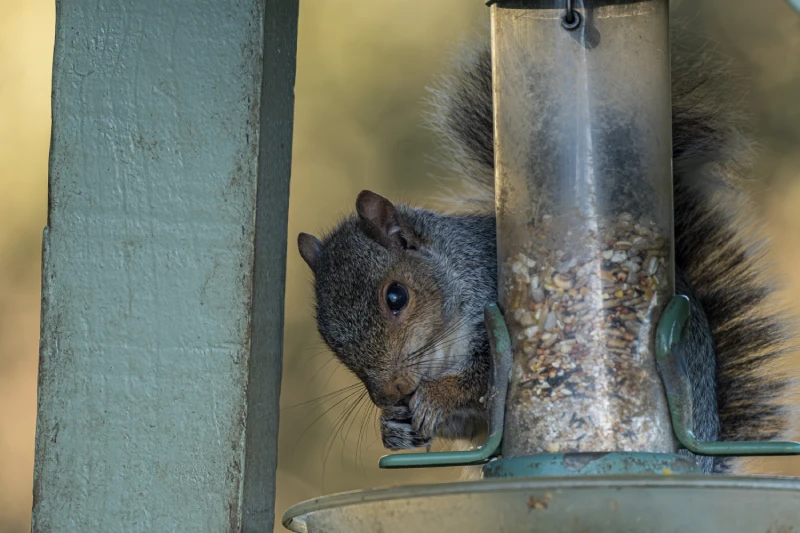
Most people will tell you to buy a "squirrel-proof" feeder and move on. That is not enough on its own, because squirrels are strong jumpers, and feeder placement matters as much as the feeder itself.
Research from birding organizations points to two numbers worth remembering: squirrels can jump about 4 to 5 feet vertically and roughly 9 feet horizontally from a standing start. That means a feeder within 9 feet of a tree branch, fence, or roofline is still reachable, no matter what the packaging promises.
Here is a setup that works well, based on that jump data:
Height: Hang or mount the feeder at least 5 to 6 feet off the ground.
Distance: Keep it at least 10 feet from trees, fences, roof edges, or anything else a squirrel can launch from.
Baffle: Add a dome or cone baffle at least 15 to 18 inches wide, placed below a pole-mounted feeder or above a hanging one. The slick, curved surface gives squirrels nothing to grip.
Pole choice: A smooth metal pole works far better than wood or a rough-coated pole, since squirrels can still climb textured surfaces even with a baffle in place.
This combination, distance plus height plus a properly sized baffle, is more reliable than any single "squirrel-resistant" product sold alone. Birds still get full access to the feeder, and squirrels lose both the jump and the climb.
Squirrels can squeeze through gaps as small as 1.5 inches wide, which is roughly the width of a fist. Their front teeth also never stop growing, so they gnaw constantly to keep them worn down, and a soft wood fascia board or a loose vent cover is an open invitation.
The most common entry points we see on Houston-area properties:
There are several signs of squirrel infestation that can give you glue. Walk the exterior of the house and look up at every corner of the roofline, every vent, and the chimney itself. Chew marks around a hole are a strong sign that a squirrel, not a smaller pest, made it.
One important rule! Do not seal any of these gaps until you are certain no squirrel, and no litter of babies, is still inside. Sealing an active entry point traps animals inside the wall or attic, where they will die, cause more damage trying to escape, and leave an odor problem that is far worse than the original issue.
If a squirrel gets into the living space of the house rather than the attic, the goal is to give it a clear, calm path back outside.
If the squirrel will not leave after 20 to 30 minutes, a live trap baited with peanut butter, walnuts, or apple slices placed near where it was last seen is the next step. Check any trap every few hours. Leaving a trapped animal for an extended period is considered inhumane in most states and can carry legal consequences.
Attic removal takes more patience than a single-room chase, because squirrels nest there and may have young that cannot yet leave on their own.
Step 1: Confirm what you are dealing with. Scratching, running, and chewing sounds around dawn and dusk usually mean squirrels rather than rats, since squirrels are most active at these times and far noisier.
Step 2: Find every entry point using the checklist above. There is almost always more than one.
Step 3: Install a one-way exclusion door over the main entry point. This is a small, funnel-style device that lets a squirrel exit the attic but blocks it from getting back in. It should stay in place for at least 5 to 7 days to give every adult, and any babies old enough to leave the nest, time to exit.
Step 4: Do not exclude during peak birthing season if you can avoid it. If young squirrels are too small to leave the nest, sealing the parent out means the babies starve inside your attic. Spring and late summer are the riskiest times for this. If you hear high-pitched chirping alongside adult activity, wait or call a professional who can safely check for and relocate a nest before sealing anything.
Step 5: Seal the remaining entry points with steel mesh or heavy-gauge hardware cloth once you are sure the attic is empty. Squirrels can chew through wood, plastic, and foam sealant, so soft materials will not hold.
Step 6: Clean and inspect the attic for chewed wiring, torn insulation, and droppings, which can carry bacteria and should be handled with gloves and a respirator.
A squirrel in a chimney is a different situation, since it is usually stuck rather than nesting comfortably.
Once the squirrel is out, install a proper chimney cap. This single fix prevents the vast majority of repeat chimney intrusions.
Getting rid of squirrels in your yard starts with removing the things that keep attracting them. Squirrels are active during the day and can quickly learn where food and shelter are easy to find. Making your property less appealing can encourage them to move elsewhere.
Secure bird feeders: Use squirrel-resistant feeders and place them away from roofs, fences, tree branches, and other surfaces squirrels can use to reach them.
Remove accessible food: Clean up fallen birdseed, nuts, fruit, and other food around the yard. Keep trash cans tightly covered.
Limit nesting areas: Trim branches that provide easy access to your roof and remove piles of brush or debris where squirrels can shelter.
Check for entry points: Look around soffits, vents, roof edges, and other areas where squirrels could move between the yard and your home. Seal openings only after confirming there are no squirrels or young inside.
Avoid feeding squirrels: Even occasional feeding can teach squirrels that your property is a reliable food source and encourage them to return.
Trapping a squirrel on your own property is legal in most states without a permit. Releasing it somewhere else usually is not.
State wildlife agencies classify squirrels as game or nongame animals, and most states treat relocation, moving a trapped squirrel off the property where it was caught, as a separate legal act from trapping itself. In states including California, New York, Oregon, and Washington, releasing a trapped squirrel anywhere other than the exact property where it was caught requires a permit from the state wildlife agency. Doing it without one can be charged as a misdemeanor wildlife violation, with fines that range widely depending on the state.
Here in Texas, the rules sit in the middle. The Texas Administrative Code allows a landowner or their agent to live-trap, transport, and release nuisance squirrels without a state permit under specific conditions, including written permission from the owner of the release property. Releasing a squirrel on someone else's land without that permission is not allowed.
Squirrels are not usually aggressive, but an attic infestation carries real health risks beyond the noise and chewed wires:
None of this means panic. It means gloves, a mask, and caution any time you are cleaning up after a squirrel has been living in your attic or walls.
DIY exclusion and trapping work for straightforward cases. Call a professional when:
Professional wildlife removal costs vary depending on the infestation, access, and any exclusion or repairs needed afterward.
This is where SkeeterCide comes in. We are a Houston-area pest control company with hands-on experience in squirrel removal, entry point sealing, and chimney cap installation, and we know the Texas rules around trapping and release well enough to handle the process correctly the first time. If you are dealing with squirrels in your attic, house, yard, or chimney and want it handled safely and legally, reach out to our team.
Once squirrels are gone, a few habits keep them from coming back:
Squirrels are persistent, but a house without easy food or easy entry stops being worth their effort. Handle the exclusion correctly once, and most homeowners never deal with the problem again.