Protecting Houston's Trails From Mosquito Pressure
Scheduled mosquito control for jogging paths, bike trails, and greenway corridors, treating the entire trail network where mosquitoes gather along the route.
Trails run through exactly the terrain mosquitoes prefer. Dense canopy blocks sunlight and holds humidity close to the ground, drainage corridors and low-lying areas sit right along the path, and the low brush lining most greenways gives mosquitoes cover to rest in during the day.
A runner passing through at dusk or a cyclist stopped at a trailhead bench does not have the option to avoid it. They are moving directly through the mosquitoes' resting zone. Bug spray wears off, and a trail that winds for two or three miles cannot be covered by a can of repellent. Professional fogging treats the corridor itself, not just the person passing through it.
.webp)
.webp)
SkeeterCide treats the entire trail corridor, not a series of disconnected access points. Our service addresses the canopy, drainage corridors, and the brush line together, so mosquito pressure drops along the full trail network, not just near the trailhead.

.avif)
.avif)
.avif)
Trails do not have a parking lot or a fence line to work from. Our mosquito exterminators plan coverage across the full route based on tree cover, drainage corridors, and access points, since a path through dense woods needs a different pattern than an open greenway.
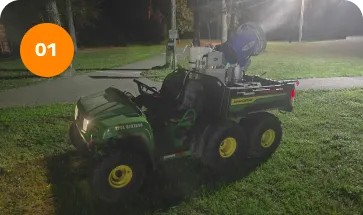
Before service begins, we map the entire trail network, including access points, wooded sections, drainage corridors, and surrounding vegetation to ensure complete coverage.
.webp)
Our licensed technicians move along the full length of the trail, directing the mist into the tree line and low vegetation on both sides of the path.
.webp)
Trails are serviced on a weekly schedule during mosquito season, since shade and surrounding vegetation keep drawing mosquitoes back.
A trail is not a smaller version of a park, and it is not a narrower street. The tree canopy, the surrounding vegetation, and the fact that people are moving through it on foot or bike, at dawn or dusk, make it one of the more mosquito-heavy environments in any neighborhood.

Treatment moves along the entire trail network instead of stopping at the trailhead or the halfway bench.
.avif)
Dense canopy and understory brush get direct treatment, since that is where mosquitoes spend the daylight hours before moving toward the path at dusk.
.avif)
Runners heading out before sunrise and cyclists finishing a ride after work get a corridor that has already been treated for peak mosquito hours.
.avif)
Trails that link parks, greenbelts, and residential streets hold up better when those connected areas are also on a fogging schedule.
Trail corridors run through wooded areas, along drainage corridors, and past homes, all in the same stretch of path. That mix calls for a different kind of judgment than a standard yard or street service.
.avif)
Backpack ULV foggers let our crews move through tree-lined paths too narrow for a fogging truck to enter.
.avif)
Applications near drainage corridors and low-lying areas follow Texas pest management guidelines, keeping treatment within labeled limits.
.avif)
Our technicians work early morning or dusk hours, when mosquitoes are active and foot traffic is light, reducing contact with runners, cyclists, and pollinators.
.avif)
Long trails often have several entry points along the route. We treat the entire network as one corridor, so coverage does not thin out between trailheads.
.avif)
We work with trail associations and community boards to schedule service around races, group rides, and other events happening along the route.
.avif)
Applications are handled by licensed pest control staff familiar with treating wooded and vegetation-heavy terrain, not just open turf.
Feedback from the neighborhoods we work with reflects what a treated corridor feels like compared to one that has not been managed.

Jake B.,
Spring, TX
.avif)
HOA Committee,
Kingwood, TX
SkeeterCide services greenways, jogging paths, and connector trails across Northeast Houston, including Kingwood, Humble, Atascocita, Porter, New Caney, Spring, and The Woodlands. If your trail is not listed, reach out anyway. We are adding new service zones regularly.

A weekly fogging plan keeps mosquito pressure down along the trails your community runs, rides, and walks every day. Give us a call and get your greenway treated before peak season hits.
Your Queries Answered Here

Yes. Many of our clients treat trails, connected parks, and neighboring streets on a coordinated schedule. Covering these connected areas together tends to produce stronger results than treating any one of them on its own.
Our fogging targets the tree line and understory brush on both sides of the trail, not just the open walking surface. That's where mosquitoes rest during the day, so treating the surrounding vegetation is what actually brings mosquito numbers down along the route.
Yes. We do not apply pesticide directly into water. Applications near drainage corridors and low-lying areas follow Texas pest management guidelines and target trailside vegetation only, staying within labeled limits. Our technicians are trained to handle these sections carefully, keeping treatment effective without compromising nearby drainage areas.
Rain can reduce how long a treatment holds, so we monitor weather conditions and reschedule when needed. Heavy rainfall right before or after a visit may also mean the trail needs to be revisited sooner than the normal cycle.
Most trails are serviced on a weekly schedule throughout peak mosquito season, depending on rainfall, shade coverage, and how close the path runs to dense vegetation. We'll help confirm a service frequency once we've walked your specific route.